Reinventing Dixie by John Bush Jones
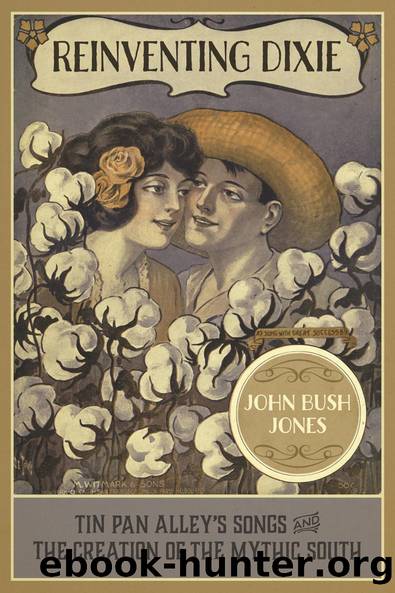
Author:John Bush Jones [Jones, John Bush]
Language: eng
Format: epub
Tags: History, United States, State & Local, South (AL; AR; FL; GA; KY; LA; MS; NC; SC; TN; VA; WV), Music, History & Criticism, General
ISBN: 9780807177358
Google: 50RIEAAAQBAJ
Publisher: LSU Press
Published: 2022-04-01T00:28:31+00:00
Authentic Southerners, White and Black
The chapter on southern social types shows how the Alleyâs Dixie tunes portrayed hillbillies and happy darkies more like cartoon characters than any real folk who ever walked the earth below the Mason-Dixon Line. Not so for a handful of songs portraying realistic poor whites and southern blacks with clarity and specificity. Though few in number, some of these songs had considerable success.
One of them was written to be sung as if by a southern poor white male and a second by a poor white or black of either gender, though the drawing on the original sheet music cover shows an elderly black man standing outside his cabin. (But sheet music art is notoriously misleading about whatâs behind it.) The song realistically depicting the life of a poor white was âAlong Tobacco Roadâ (Edward B. Marks, 1935), with Tina Glennâs words and Jesse Greerâs music. It was inspired by Jack Kirklandâs long-running Broadway hit Tobacco Road, based on Erskine Caldwellâs novel. The original sheet music cover featured a photo of James Barton as Jeeter Lester, who in 1934 succeeded Henry Hull as the dirt-scratching, foul-mouthed, Georgia tobacco sharecropper. âAlong Tobacco Roadâ is a homesickness song that begins, âHomesick, Lonely, Tired of all that I see,â but the home the singer longs for is a far cry from the idyllic spots in the next chapterâs songs. Itâs a place where âlife means plantinâ, where life means slavinâ, / Where life gives what youâve sowed. / ⦠/ Thoâ youâre hungry and worn, clothing shabby and torn, / You smile but never complain. / So you plough and you plough, ⦠/ âTil your body is doubled with pain, / Yet you ask no reward, in your prayâr to the Lord, / But forever here to remain.â
The sheet music cover aside, thereâs nothing in Mort Dixonâs lyric for âRiver, Stay âWay From My Door,â with Harry Woodsâs music (Shapiro, Bernstein, 1931), to indicate whether the singer is a poor white or a black, or even male or female; indeed the top-selling recording was Kate Smithâs with Guy Lombardo and His Royal Canadians on Columbia in 1931. Her beautifully sung and moving rendition can be heard on the Internet. Other popular 1931 records of the song were made by Phil Harris on Victor and the Boswell Sisters on Brunswick, all of them white, and the great black singer/actor Paul Robeson on Victor. Arguing that the persona in the piece was intended to be a poor white is that, unlike the following songs to be sung by southern blacks, this first-person lyric employs no ethnic accent or dialect, or substandard English. Entirely in the first person, a poor elderly southerner apostrophizes to what he calls âjust a lonely little river,â making it clear he doesnât live on the banks of the Mississippi. Nor does the song reflect the Great Flood of 1927. Still, the singer knows rivers can overflow their banks, so he begs, âI donât bother you / Donât you bother me.
Download
This site does not store any files on its server. We only index and link to content provided by other sites. Please contact the content providers to delete copyright contents if any and email us, we'll remove relevant links or contents immediately.
| Biographies | Business |
| History & Criticism | Instruments |
| Musical Genres | Recording & Sound |
| Reference | Songbooks |
| Theory, Composition & Performance |
The Goal (Off-Campus #4) by Elle Kennedy(13681)
Kathy Andrews Collection by Kathy Andrews(11844)
Diary of a Player by Brad Paisley(7584)
Assassin’s Fate by Robin Hobb(6227)
What Does This Button Do? by Bruce Dickinson(6209)
Big Little Lies by Liane Moriarty(5807)
Altered Sensations by David Pantalony(5106)
Pale Blue Dot by Carl Sagan(5012)
Sticky Fingers by Joe Hagan(4204)
The Death of the Heart by Elizabeth Bowen(3625)
The Heroin Diaries by Nikki Sixx(3552)
Confessions of a Video Vixen by Karrine Steffans(3312)
Beneath These Shadows by Meghan March(3311)
How Music Works by David Byrne(3272)
The Help by Kathryn Stockett(3152)
Jam by Jam (epub)(3095)
Harry Potter 4 - Harry Potter and The Goblet of Fire by J.K.Rowling(3076)
Computational Linguistics and Intelligent Text Processing: 20th International Conference, CICLing 2019 La Rochelle, France, April 7â13, 2019 Revised Selected Papers, Part I by Alexander Gelbukh(2996)
Strange Fascination: David Bowie: The Definitive Story by David Buckley(2873)
